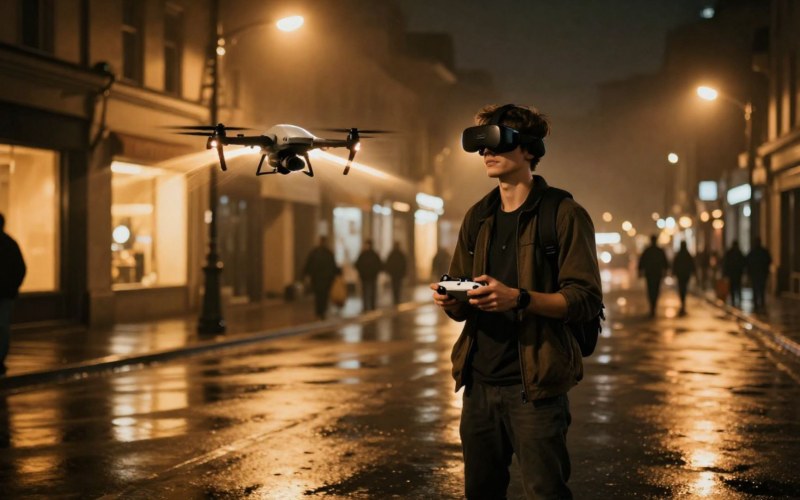
From the psychology of the zoom-in lean-forward to FPV drones flying through doorways in a single shot — the tools and techniques reshaping social media marketing in 2025, and what Vietnamese brands should do about it.
The Scroll Has Become the New Storefront
Ten years ago, a brand needed a TV budget to interrupt someone's evening. Today, a single well-crafted 15-second video can stop a thumb mid-scroll and deliver a brand impression to a million people before breakfast. The rules of marketing have not just evolved — they have been rewritten by a generation of creators who understand attention at a neurological level, armed with tools that cost nothing and produce results that rival broadcast production.
This article is a map of that new landscape: the platforms shaping it, the psychological tricks powering it, the sounds scoring it, and the drones about to take it somewhere entirely new.
CapCut: The Studio in Everyone's Pocket
If one tool defines the democratisation of video marketing, it is CapCut. Launched by ByteDance (the company behind TikTok) in 2020, CapCut has become the default editing environment for a generation of content creators — and increasingly, for serious marketing teams. Its template library is a real-time feed of what is working on social media right now. When a transition style, a text animation, or a colour grade starts going viral, it appears in CapCut's trending templates within days. For marketers, this is a live signal board of visual culture.
What makes CapCut genuinely powerful is the combination of AI-driven tools — auto-captions, background removal, AI voiceover, smart cut to beat — with an interface anyone can use in under an hour. A brand that used to spend three days in post-production can now cut a polished, on-trend social video in 40 minutes. The quality ceiling is no longer set by budget; it is set by creative judgment.
One of CapCut's most powerful features for brand teams is its trending template feed — a constantly refreshed library of formats that are actively performing on TikTok. Templates tagged as viral or trending are effectively pre-validated creative frames: the structure has already proven it can hold attention. Brands that plug their own footage into these templates are borrowing equity from the viral moment the template was built on.
The Lean-Forward Effect: Visual Hooks and the Unconscious Brain
The most effective social media videos do not start with a logo or a product shot. They start with a psychological trigger — a visual or auditory cue that overrides the brain's skip reflex and compels the viewer to stay. The most powerful of these is the zoom-in hook.
When a video begins with a slow, deliberate push into the frame — the camera closing in on a face, a product, a moment — something happens in the viewer's body that they do not consciously notice. They lean forward. This is a deeply wired survival response: the brain interprets an approaching object as potentially important and prepares the body to engage. On a phone screen, that lean-forward gesture translates directly into watch time, and watch time is the currency that every platform algorithm rewards.
"The brain cannot distinguish between a zoom happening on screen and an object approaching in real life. The lean-forward response is involuntary — and for the three seconds it takes to kick in, you own the viewer's full attention."
Other high-performing visual hooks used by top creators:
- The pattern interrupt: A sudden cut to black, a freeze frame, or an unexpected colour shift that forces the brain to reset and re-engage.
- The reveal structure: Withholding information just long enough to trigger curiosity — the brain physically cannot leave an open loop without resolution.
- Whip pan transitions: Fast lateral camera swings that carry energy and momentum from one shot to the next, keeping kinetic tension high.
- First-person POV: Placing the viewer's perspective inside the experience rather than outside it — a technique that activates mirror neurons and creates immediate emotional identification.
- Text as tension: Bold on-screen text that appears mid-sentence, forcing the viewer to wait for the completion of a thought they are already invested in.
Sound: The Invisible Hook That Works First
Before the eye fully registers what it is seeing, the ear has already processed the audio and begun forming an emotional response. Sound is the fastest hook in video, which is why the choice of music, sound effect, or opening audio cue is not a finishing detail — it is the first creative decision.
Trending sounds on TikTok and Instagram Reels create what researchers call auditory priming: when a viewer recognises a sound they have heard in dozens of other contexts, they are pre-loaded with the emotional register of those previous experiences. A sound associated with humour prepares the brain to find the following content funny. A sound associated with awe prepares it to be impressed. Smart brands find trending sounds before they peak — when the algorithm is still rewarding novelty — and attach their content to that emotional pre-loading.
Beyond trends, the structural elements of great brand audio include:
- The opening non-word: A gasp, a beat drop, a foley sound (a slap, a click, water) in the first 0.5 seconds — before music, before voice — that registers as a physical sensation and stops the scroll physiologically rather than intellectually.
- Voice pace and pitch: Faster speech signals excitement and urgency; measured, lower-pitched narration signals authority and trust. Neither is universally correct — the choice must match the brand register.
- Silence as emphasis: A sudden drop in audio after sustained sound forces the brain to attention. Used at a key message moment, it can be more powerful than any music swell.
Content Seeding: Planting Ideas Before the Sale
The most sophisticated social media marketing does not look like marketing at all. Content seeding is the strategy of distributing brand messages through organic-feeling content — creator collaborations, conversation-starting posts, educational explainers — that build familiarity and preference long before a purchase decision arises. The consumer who sees your brand in seven unrelated contexts over three weeks does not remember seeing an ad; they remember having a positive feeling about you when it matters.
TikTok's algorithm is uniquely suited to seeding: it distributes content based on engagement signals rather than follower count, meaning a piece of genuinely resonant content from a brand account with 200 followers can reach 200,000 people if it holds attention. The implication for Vietnamese businesses is significant — the playing field between established brands and new entrants is flatter on TikTok than on any other platform in history.
FPV Drones: The Most Exciting New Tool in Brand Video
If CapCut democratised editing, FPV drones are democratising the kind of shot that used to require a helicopter, a film crew, and a six-figure budget.
FPV stands for First Person View. Unlike a conventional drone that hovers and pans gently, an FPV drone is a racing machine — small, extraordinarily fast, and capable of manoeuvres that a standard camera drone cannot perform. The pilot wears a headset that streams a live feed from the drone's camera, giving the sensation of flying through the scene in real time. The resulting footage is visceral, immersive, and impossible to replicate with any other camera system.
A conventional drone can fly through an open space smoothly. An FPV drone can fly through a doorway, dive between two buildings, spiral around a skyscraper, enter a moving vehicle through the window, and land on a table — all in one continuous shot with no cuts. For brand videos, this translates into a kind of visual storytelling that feels genuinely cinematic and earns attention in a way that standard aerial footage no longer does.
The Most Popular FPV Drones in 2025
DJI Avata 2 — The Professional Standard
The DJI Avata 2 is the gold standard for commercial FPV work. Released in 2024, it shoots 4K/60fps with a wide-angle lens and uses DJI's O4 video transmission for a clean, lag-free FPV feed. Crucially, it has electronic image stabilisation that smooths out the turbulence inherent to fast FPV flight — making the footage usable without the juddering that plagued earlier FPV cameras. Paired with DJI Goggles 3, it offers a 100° field of view and a pass-through mode so the pilot can see the real world overlaid with the live feed. Price range: approximately $700–900 USD.
DJI Neo — The Accessible Entry Point
Launched in late 2024, the DJI Neo is a palm-sized, lightweight FPV-style drone aimed at creators who want dynamic, close-proximity footage without the steep learning curve of freestyle flying. It weighs just 135g, shoots 4K, and has enough obstacle sensing to make it genuinely usable in tighter spaces. For brands that want FPV-feel content without hiring a specialist pilot, the Neo is currently the most interesting entry point on the market.
Custom Freestyle Builds — For the Real Cinematics
The most spectacular FPV footage in music videos, brand campaigns, and film production is typically shot on custom-built freestyle drones — hand-assembled from components chosen by the pilot for the specific demands of each shoot. Common frames include the iFlight Nazgul and Geprc Mark series. These drones are faster, more manoeuvrable, and significantly louder than consumer FPV drones. They require skilled pilots and often a dedicated safety coordinator on set, but the footage they produce is in a different class entirely.
Cameras typically mounted on custom builds include the GoPro Hero 13 Black with HyperSmooth stabilisation, or the DJI Action 4 for its superior low-light performance. The combination of a skilled freestyle pilot and a Hero 13 in a sub-250g custom build can produce footage that looks like it cost ten times what it did.
What FPV Footage Does to the Viewer's Brain
The psychological effect of FPV footage mirrors the zoom-in hook at a macro scale. When a viewer watches an FPV shot that dives through a building or spirals around a product, the brain interprets the forward motion as the viewer's own movement. Mirror neurons fire. The body leans in. Watch time spikes. For brands in hospitality, real estate, automotive, events, and F&B, FPV is rapidly becoming the differentiating production choice — not because it is new, but because it creates the one thing every brand wants: a memory that feels physical.
What Vietnamese Brands Should Do Right Now
The window to stand out with these techniques is still wide open in the Vietnamese market. Most brands are still producing polished-but-static content — talking heads, product shots, safe music beds. The brands that move first on FPV production, on psychological hook structures, on audio-first social content, will own the category impression before the market catches up. MARCOMS works with both the creative strategy and the production execution — from CapCut-native social content to full FPV production shoots across Ho Chi Minh City. Talk to us about what this looks like for your brand.